
The Most
Eco-built Multihull
Sustainability and ecology are one of the watchwords of Windelo and we have taken an uncompromising and innovative approach to construction in order to achieve this. Our ground breaking use of sustainable volcanic basalt and PET – made from recycled bottle plastic in the hull construction – puts Windelo at the forefront of the green revolution.
Our new construction site brings another unusual aspect of our project to the fore: an eco-design approach applied to our materials and construction processes. The Windelo catamarans structure is made from a new innovative environmentally-friendly composite sandwich. We carried out studies in partnership with researchers from Mines d’Ales with a view to using the most eco-friendly materials.
Our eco-friendly composite sandwich mixes basalt fiber and PET from recycled plastic bottles and reduces carbon emissions by nearly 50% compared with traditional GRP composite manufacturing methods.
Basalt fiber
Basalt – yes, that’s right, the byproduct of a volcanic eruption – became the factor that solved the mystery of how to build a light, sustainable hull. Basalt fibers have actually been produced for many years now (in wind turbines for instance) but Windelo catamaran is among the first to use it in yacht construction.
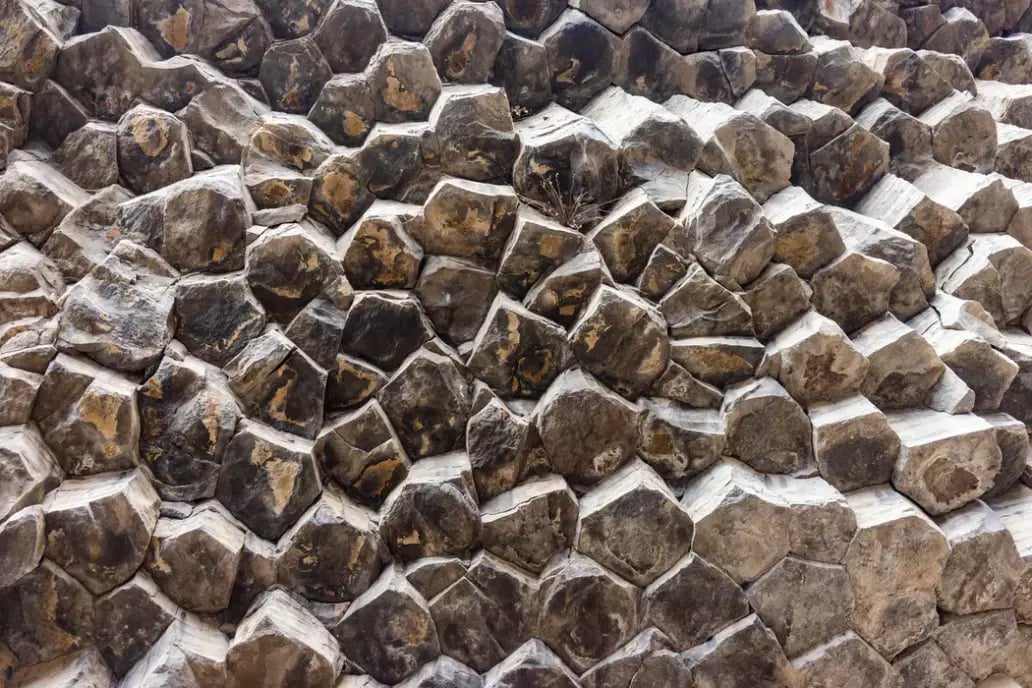
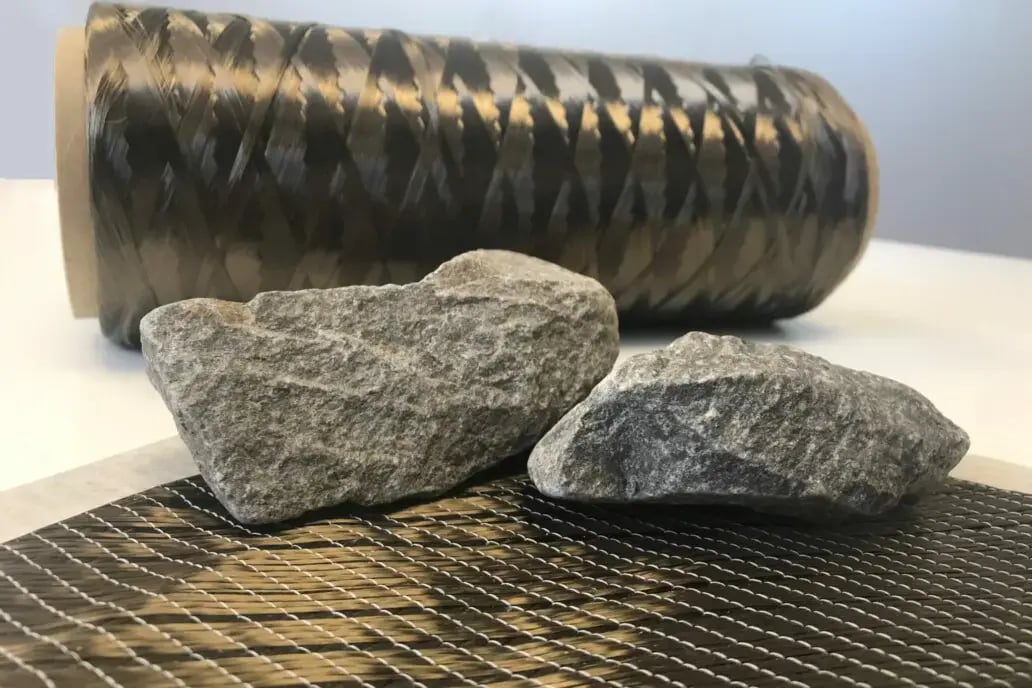
Basalt rock is one of the main constituents of the ocean crust and is an abundant resource. No additives are needed to transform it, which reduces carbon emissions by 10.
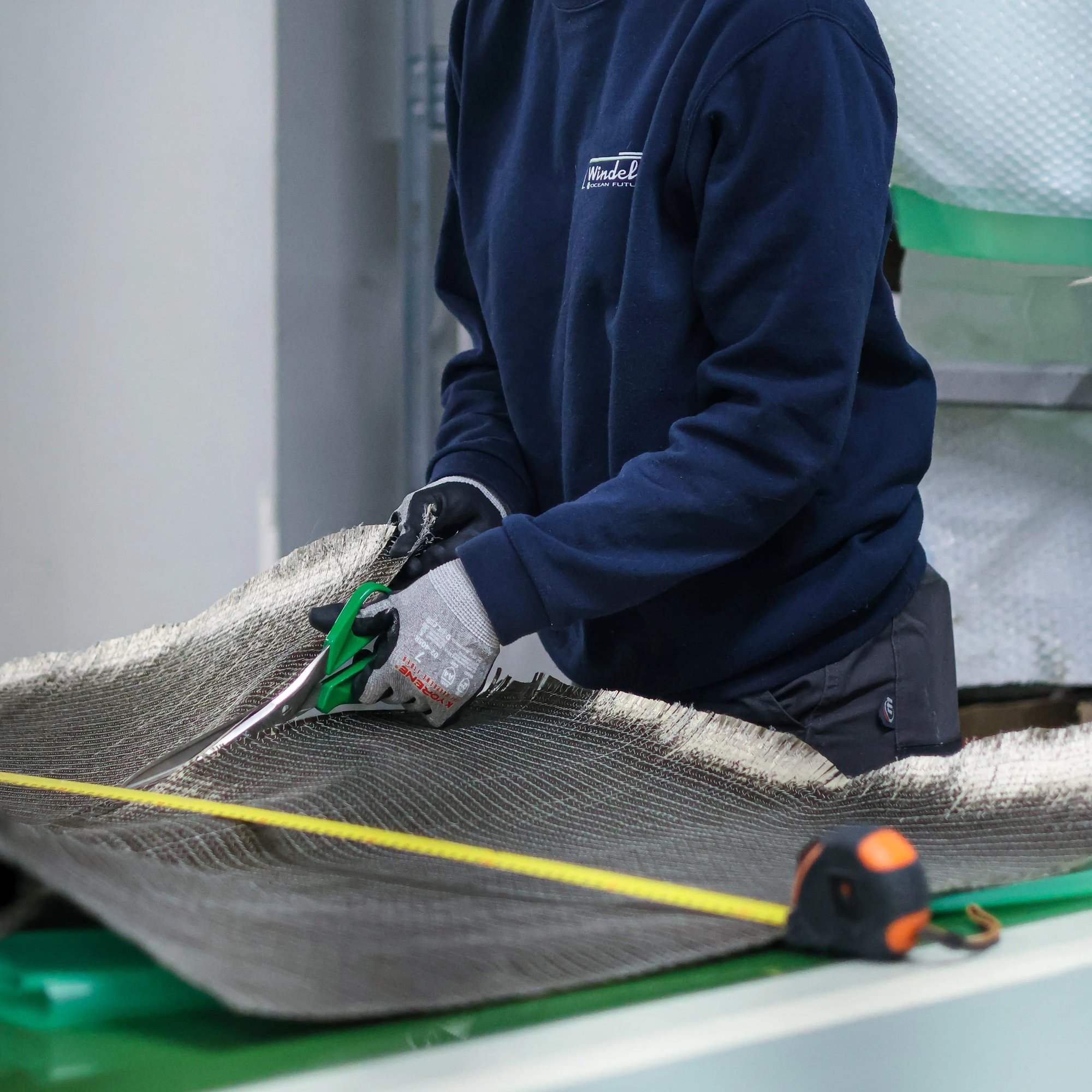
We mostly use basalt fiber in the structure of our boats. Basalt is a natural volcanic fiber that offers vibration resistance and durability while still maintaining a high strength-to-weight ratio.
These Basalt laminates are used to construct a stiff, light, and much more sustainable hull compared to traditional fiberglass construction. The basalt fiber presents high fire resistance, high heat resistance, and high mechanical features. The basalt fiber can be fully recycled by being redesigned in the oven and rewooped.
PET foam
Generally, yachts’ hulls are constructed using a foam core which is not very good for the environment. PET – made from recycled PET, mainly from reused drinking bottles – get around that issue, being both light and 100% recycled.
-1%20(1).webp "plactic bottles to PET foam process")
PET foam is a key part of the jigsaw that ensures the hull of the Windelo catamarans is far kinder to the environment than traditionally constructed rivals.
PET foam is made from recycled PET, mainly from reused old drinking bottles which are crushed into very small pieces then melted again in order to create the PET foam. During the fabrication process, the PET core produces half of CO2 than the PVC (traditional material used in boat contruction) core does.
80kg/m3 PET foam is used for 56% of our catamaran’s structure (hull and bulkheads).
Compared with an equal density of PVC, the mechanical properties of PET show a lower shear resistance. So, the solution is to increase the PET density to 115kg/m3 in order to obtain an equivalent shear resistance, i.e. 80kg/m3. This results in an excess weight of around 600kg on our boat, which is too much for our high-performance catamarans.
So, we decided to create a mixture of PET 80kg/m3 and PVC 80kg/m3, to match the structural constraints of the boat.
Furthermore, we are currently working with our PET foam supplier to improve shear resistance and resin absorption, to be able to steadily increase the quantity of PET foam we use in our boats.
Composite materials (in Basalt fiber and PET foam) have been tailored to the structure but also to indoor fittings, furniture, and floors, which optimize the weight of the Windelo catamarans.
FSC wood
FSC wood is used throughout Windelo’s interior. This means the wood has been certified by the Forestry Stewardship Council and therefore attains the stringent standards of the council in order to ensure the wood is sourced in an environmentally responsible and socially beneficial manner.