

Achieving energy autonomy has always been a key element of the Windelo project. However, unlike an electric vehicle or a straightforward rechargeable device, energy management on a large sailing yacht is far more complex.
Energy production, storage, and consumption occur simultaneously on a Windelo.
Electricity production depends on several variables, such as weather conditions, the boat’s speed, or the energy source being used (solar, wind, hydro-generation, or generator).
Two concepts work in synergy: energy balance (production vs. consumption), which requires powerful energy sources, and battery storage capacity to handle consumption peaks and compensate for production drops.
Moreover, to ensure safety at sea, an energy reserve is essential, which is why Windelo catamarans are equipped as standard with a powerful diesel generator capable of providing engine propulsion for nearly 1,000 nautical miles.
.webp?width=2880&height=1620&name=Windelo50-solaire-point-fort-2880x1620%20(1).webp)
In Summary
Electric & hybrid drive system
220V / 110 SYSTEM
48V System
24V System
Source distribution

Shore supply
16A - 32A

Generator(s)
17.9 kW - 35.8 kW
Photovoltaic solar
panels up to 6000W

Wind turbine
400 W - 800 W
Transformation / Energy

Charger / Inverter
10 kVA


Propulsion Batteries
53.8 kWh / 1120 Ah 48 V

Service Batteries
6,7 kWh - 13.4 kWh
Distribution

AC 230 V / 110 V

Port Engine
20 kW
Starboard Engine
20 kW

DG 24 V
Energy Balance
The balance achieved between production and consumption is one of the keys to energy autonomy.
Windelo catamarans are designed to ensure continuous energy production, enabling “energy self-sufficiency” without the need for fossil fuels.
Does achieving this energy balance require minimal use and strict monitoring of energy flows? We have scaled Windelo’s systems to make sailing both comfortable and eco-friendly.
Here are three distinct uses that go beyond conservative estimates and actually achieve energy balance through solar and hydro-generation, without tapping into battery capacity.
In the following simulations, green energy production is sufficient to meet all daily electricity needs.
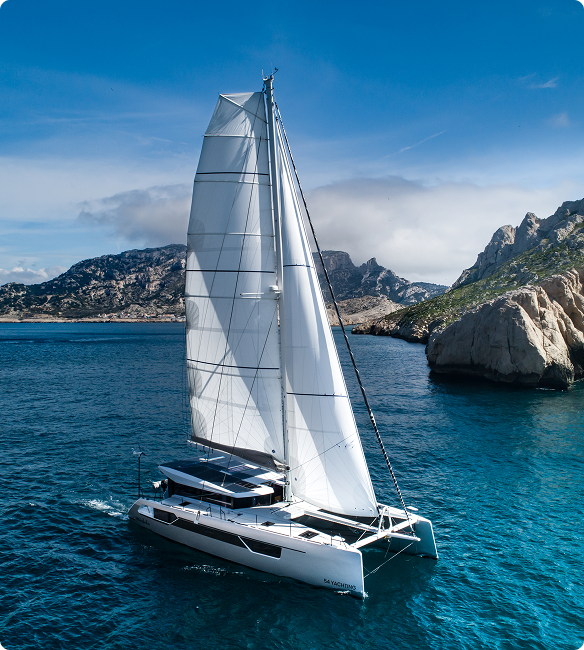
Windelo catamarans are designed for ambitious voyages and long crossings. Thanks to their slender hulls and powerful sail plans, they move quickly even in light winds, achieving speeds that produce energy continuously via hydro-generation.
Unlike heavier sailboats, a Windelo can sail exclusively under wind power, reducing its engine consumption.
This is how performance and energy autonomy work hand in hand aboard a Windelo.
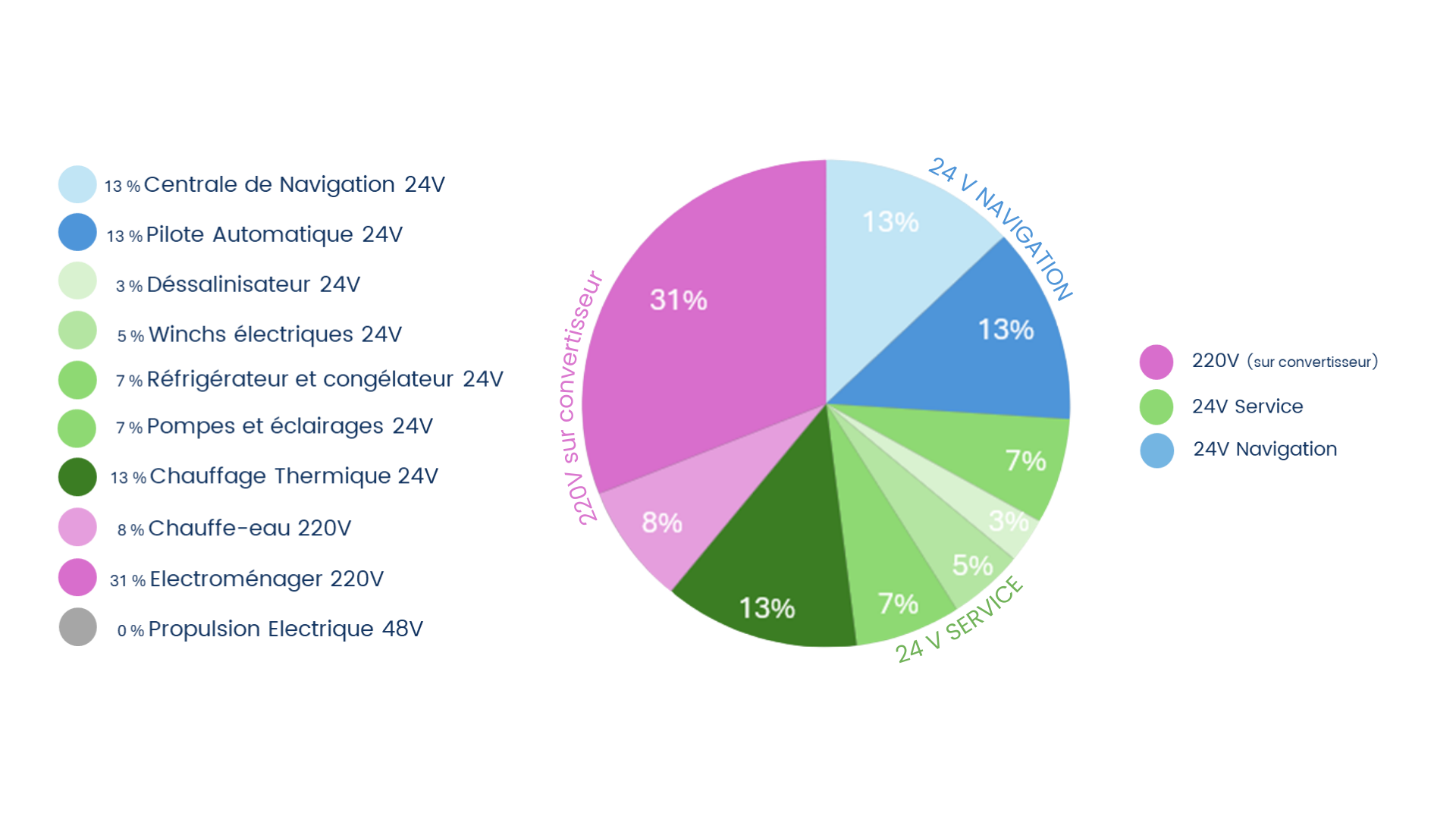
For blue-water sailing, energy needs primarily include navigation systems, the autopilot, the water maker, and service equipment (lighting, pumps, appliances). Depending on the season and latitude, thermal heating may also be required.
Windelo catamarans have excellent natural ventilation, making air conditioning unnecessary while sailing.
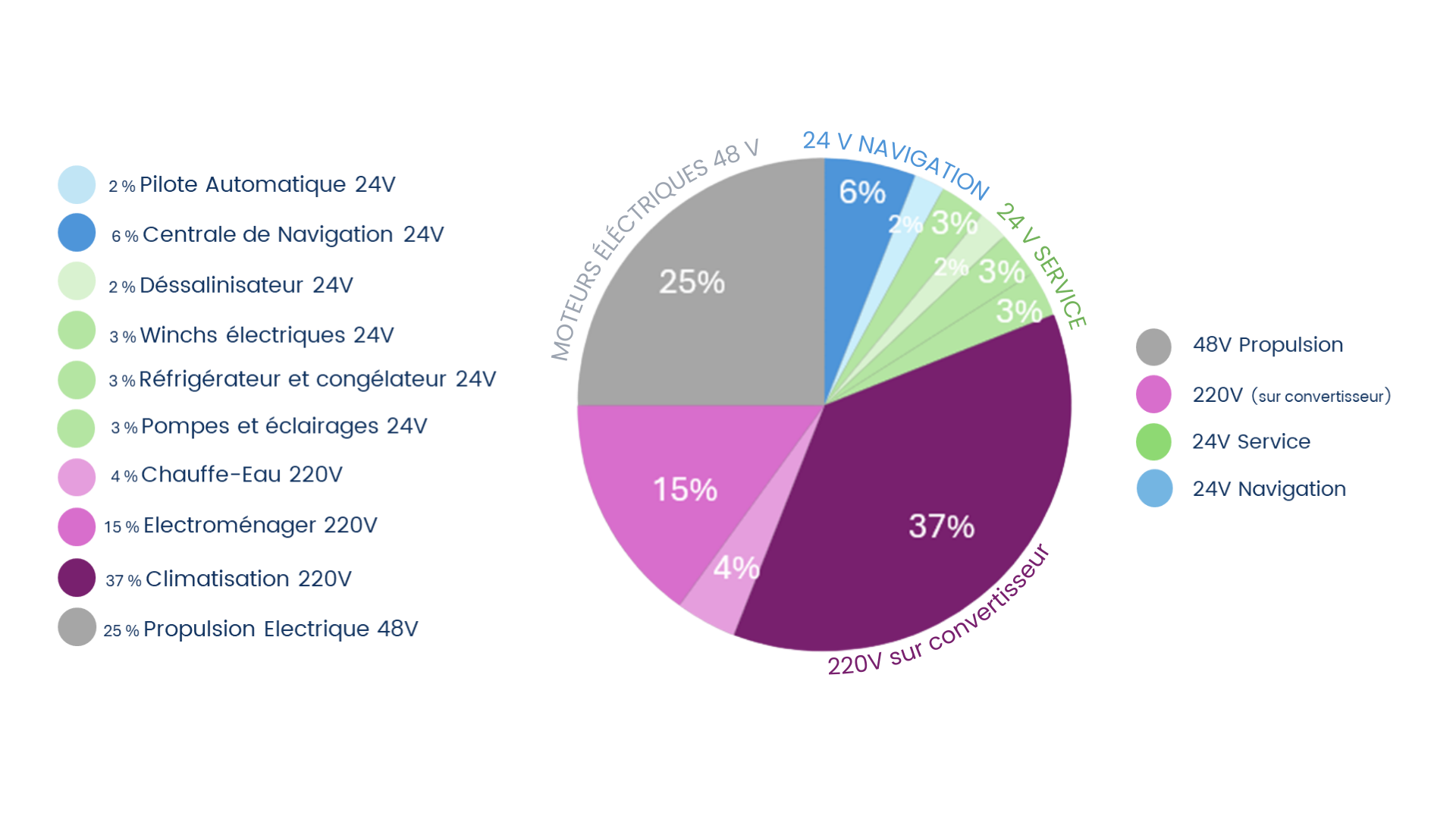
Ocean Sailing Daily Energy Requirements:
When ocean sailing, hydro-generation is prioritized, as the boat is constantly in motion. If the wind strength is insufficient to reach the required speed, solar power serves as an alternative energy source.
In optimal wind and sunlight conditions, both energy sources combine to recharge the batteries fully.
Ocean sailing energy balance:
1 - 12 hours of hydro-generation at an average speed of 10 knots cover the daily electricity needs.
Note: Hydroelectricity production requires a sailing speed of at least 8 knots, achieved with an apparent wind of 15 knots.
2 - Energy balance can also be achieved through solar packs:
- Pack 1 : 1180 W – 24 V
- Pack 2 : 2325 W – 48 V
Note: Sunlight intensity varies throughout the day depending on the sun’s angle and shadows.
To provide a more accurate estimate of daily production, solar panel output is calculated at 35% of their peak power, assuming an average sunlight exposure of 80%.
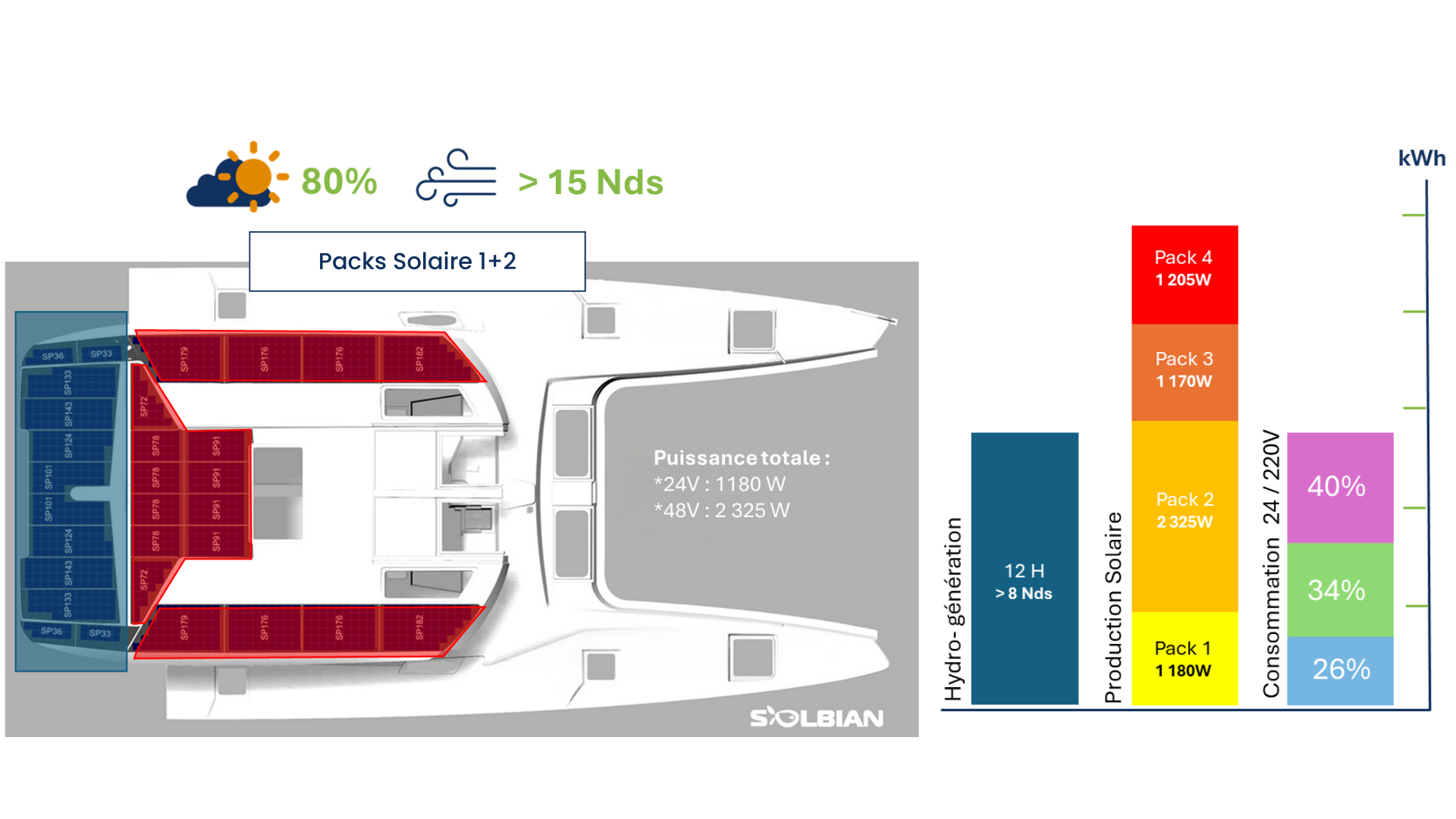
Ocean Sailing Scenario Details:
*Navigation electronics: 24/24H
*Electric propulsion: 0H
*Air conditioning: 0H
*Heating: 3H
Daily Solar Production:
*35% of peak power
Hydro-generation:
*Hydro-generation time: 12H
This navigation program requires more energy, as it combines the use of all onboard equipment and electric motors.
When cruising along the coast, the boat sails 10 hours per day, including one hour under motor power for anchorage approach.
Air conditioning is also used, powered by the lithium battery bank.
Coastal Sailing daily energy requirements:
Production & Energy Balance:
When sailing along the coast, the combined production of the following solar packs covers 84% of energy needs:
- Pack 1 : 1180 W – 24 V
- Pack 2 : 2325 W – 48 V
- Pack 3 : 1170 W – 48 V
- Pack 4 : 1205W – 48 V
As with ocean sailing, solar panel production is calculated at 35% of their peak power.
4 hours of hydro-generation at speeds exceeding 8 knots cover the remaining 16% of onboard energy needs, achieving energy balance.
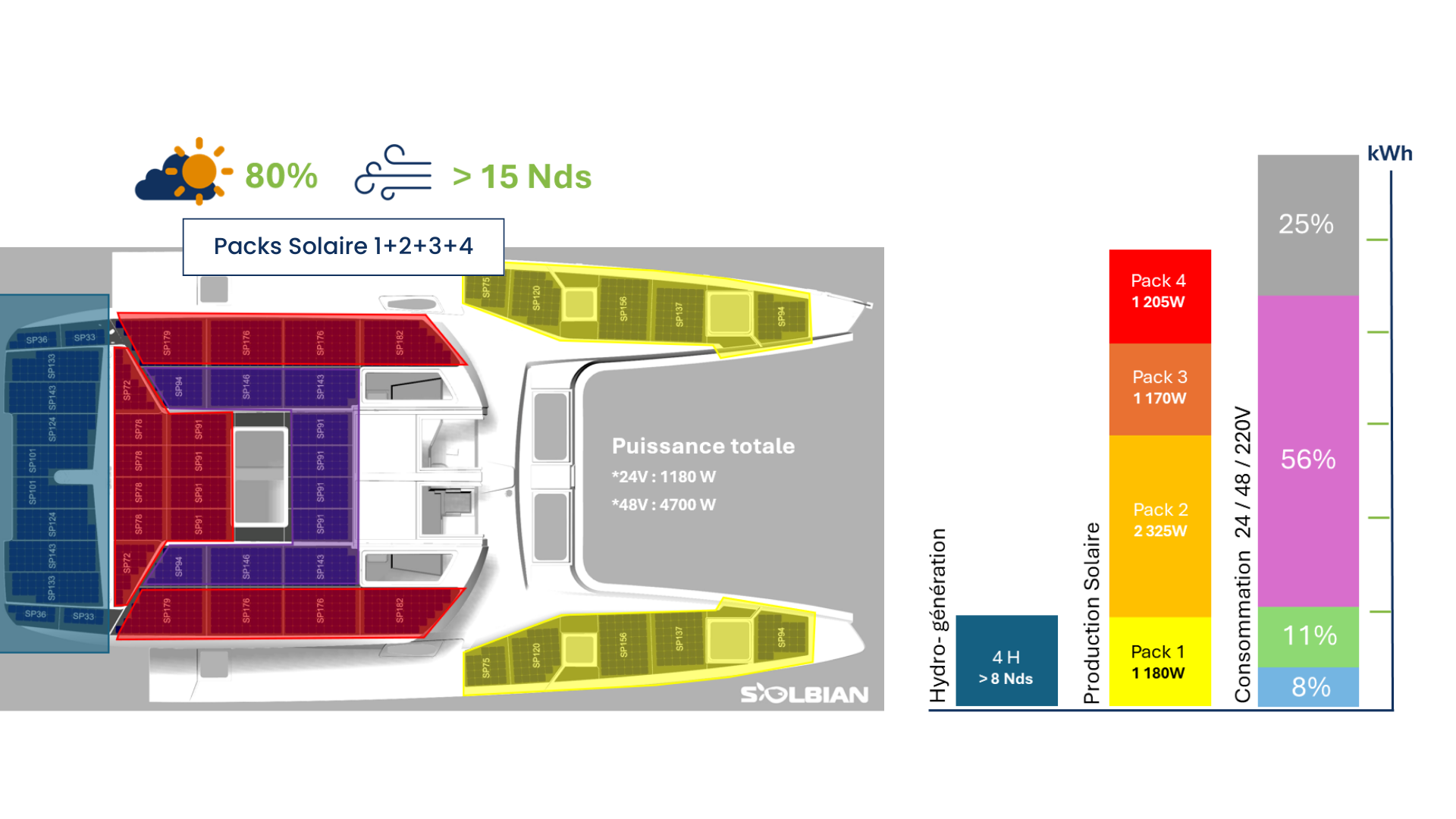
Coastal Sailing Scenario Details:
*Navigation electronics: 24/24H
*Electric propulsion: 1H
*Air conditioning: 3H (24-50 kBTU)
Daily Solar Production:
*35% of peak power
Hydro-generation:
*Hydro-generation time: 4H
In this case, Windelo prioritizes comfort and quality of life by deploying its full range of service equipment.
Electric propulsion and navigation systems, such as electric winches, windlass, and the autopilot, are not used, and hydro-generation is not possible. Energy production depends solely on solar panels.
In this case, we take into account the regular use of 220V appliances and 3 hours of air conditioning for optimal comfort.
Anchorage Daily Energy Requirements:
.webp)
Production & Energy Balance:
At anchor, the combined production of the following solar packs covers 95% of energy needs:
- Pack 1 : 1180 W – 24 V
- Pack 2 : 2325 W – 48 V
- Pack 3 : 1170 W – 48 V
As with the other cases, solar panel production is calculated at 35% of their peak power.
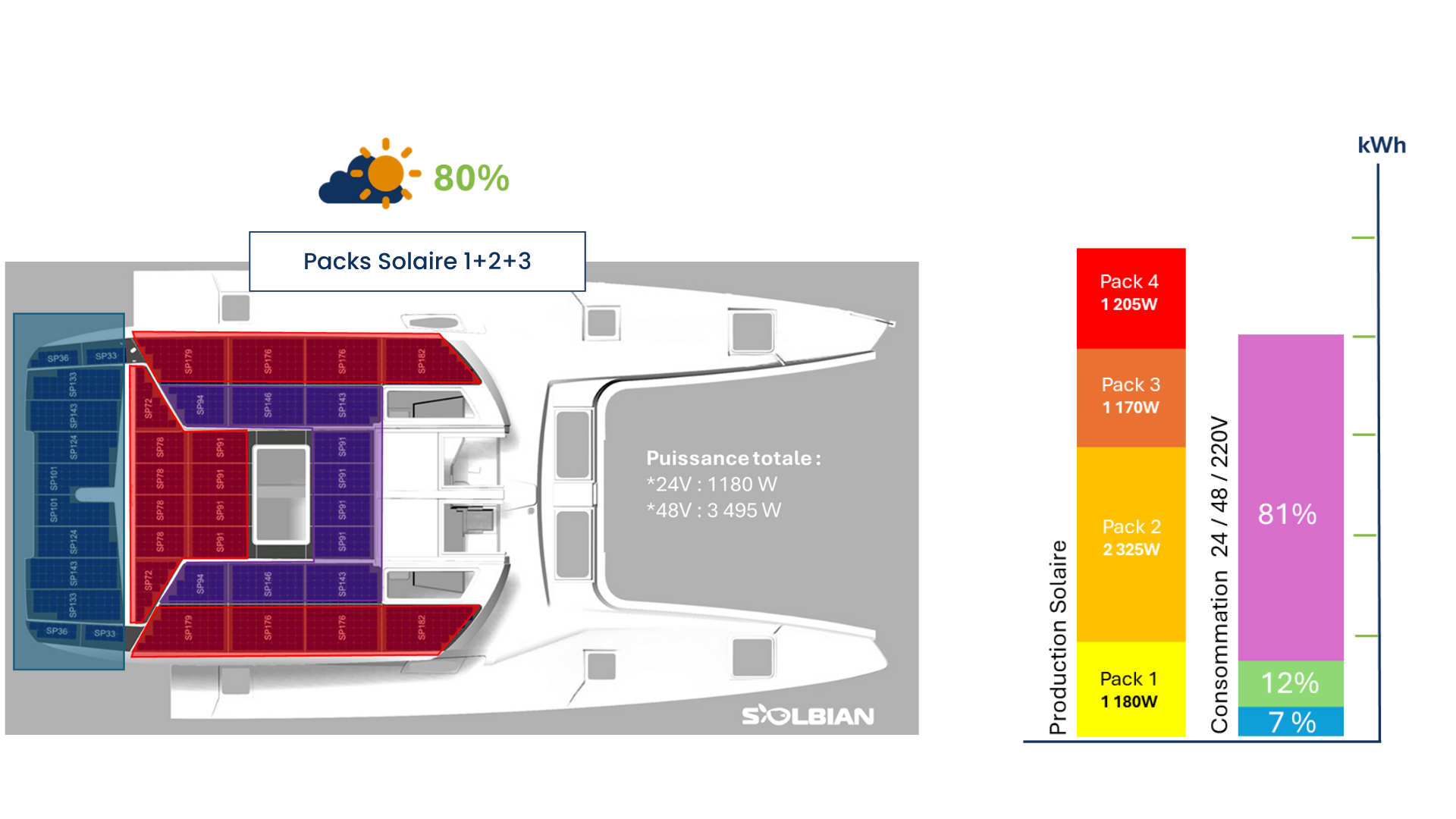
Anchorage Scenario Details:
*Navigation electronics: 24/24H
*Electric propulsion: 0H
*Air conditioning: 3H (24-50 kBTU)
Daily Solar Production:
*35% of peak power
Hydro-generation:
*Hydro-generation time: 0H
Backup Generator
Windelo catamarans come as standard with a 48V / 18kW diesel generator powered by 500L of fuel.
This ample energy reserve allows for:
- Rapid battery recharging,
- Long-range motor propulsion (+/- 1,000 nautical miles),
- Onboard equipment operation when batteries are depleted.
With electric propulsion backed up by a generator, Windelo’s motor performance and autonomy match that of boats fitted with a combustion engine.
Diesel hybridization provides additional power to handle demanding weather conditions. However, in most situations, proper energy management and anticipation eliminate the need for generator support.
Several owners of our boats have proven that Windelo catamarans can sail without relying on fossil fuels.
Sailing and efficient energy management are the keys to green autonomy aboard Windelo.
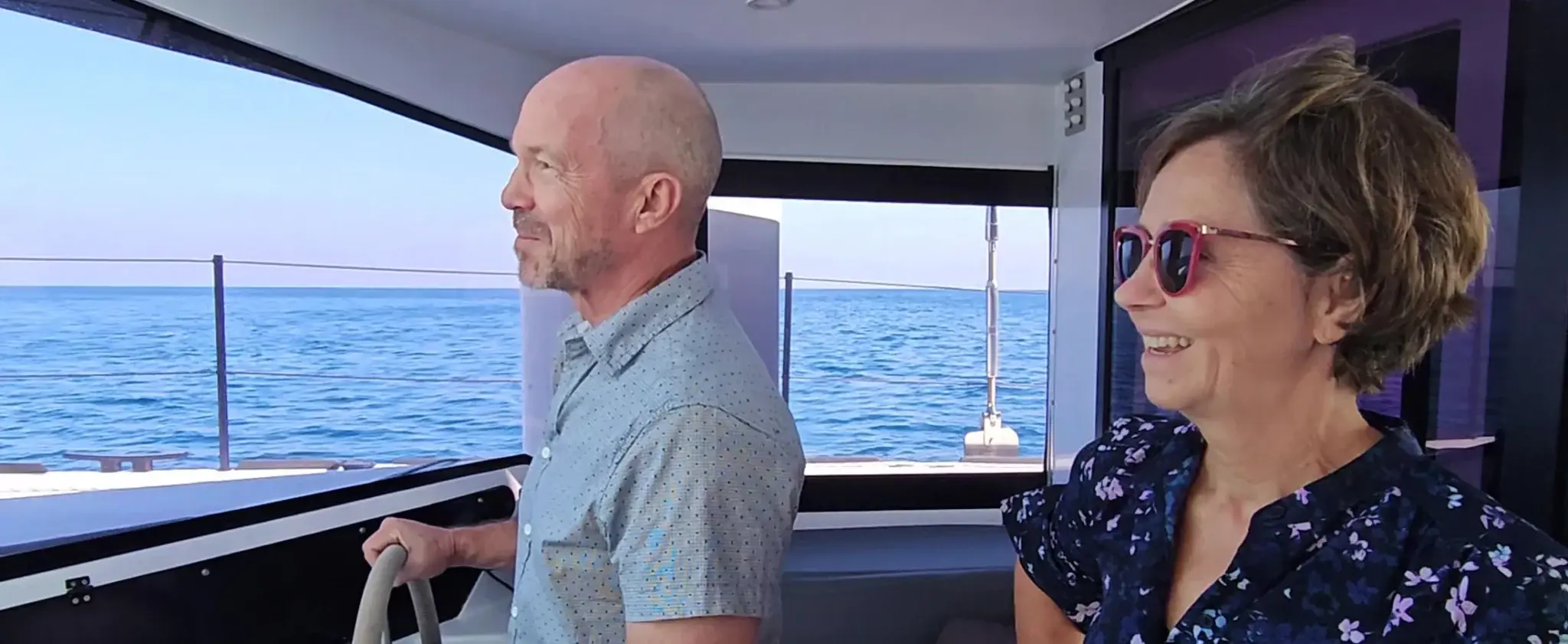
Owners Testimonial - Manon and Robert
Ahoy sailors! We had the pleasure of interviewing Manon and Robert, the proud owners of B Cube, a Windelo 54 Adventure catamaran. They recently completed a 10-month voyage in the South Atlantic and shared their experience aboard their amazing catamaran with us.
Energy Storage
Energy production and consumption are not always perfectly synchronized, as critical situations and energy demands vary with navigation conditions.
In rough seas, autopilot consumption increases, and heating or air conditioning may be necessary depending on latitude. Additionally, weather conditions— sunlight, wind, sea state—constantly influence energy production.
To ensure optimal autonomy, Windelo catamarans are equipped with a substantial battery bank that satisfies essential energy needs, even at times when renewable energy production is temporarily insufficient.
Battery Bank Composition, a 24/48V battery bank with 60kWh… as standard:
24 V / 6.7 kWh Battery Bank:
- 1 Lithium battery (280Ah / 24V).
- Recharged via dedicated solar panels and, if necessary, from the 48V bank through an inverter.
48 V / 53.7 kWh Battery Bank:
- 8 Lithium batteries (280Ah / 24V), paired in series and connected in parallel.
- Recharged via solar panels, hydro-generation, wind turbines, or the generator.
The 48V battery bank provides 4 hours of motor propulsion (+/- 20 nm at 6 knots) without using the generator, or ensures several days of electrical autonomy depending on the type of navigation.